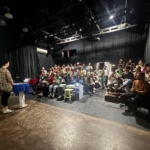
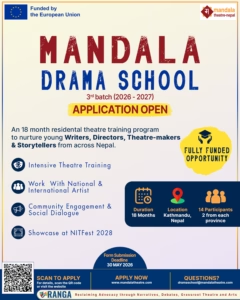
Mandala Theatre-Nepal invites applications for the 3rd Batch of Mandala Drama School (MDS) — an 18-month residential theatre training program designed to nurture young theatre-makers, storytellers, and cultural leaders from across Nepal.
This fully-funded program is implemented under the project “Reclaiming Advocacy through Narratives, Debates, Grassroot Theatre and Arts (RANGA)”, supported by the European Union.
With the focus on nurturing young playmakers, Mandala Drama School combines intensive practical training with creative playmaking, community engagement, and social dialogue. The program focuses on developing skills in acting, directing, playwriting, production, and participatory theatre methods, while encouraging students to explore local stories, social issues, and inclusive storytelling practices.
The training is structured in three semesters over 18 months, including:
- Ensemble productions and performance practice
- Creative writing and play development
- Participatory theatre (Forum, Playback, Documentary Theatre)
- Community engagement and practice teaching
- Technical theatre training using local resources
After completing the course, participants will return to their provinces to develop and stage original productions, which will be showcased at the Nepal International Theatre Festival (NITFEST) 2028.
What the Program Offers
- Intensive professional training in theatre and playmaking
- Opportunity to work with national and international artists
- Hands-on experience in productions and performances
- Exposure to community-based theatre practices
- Opportunity to present work at NITFEST 2028
- A network of theatre practitioners across Nepal
Who Can Apply?
We are looking for motivated young individuals who are passionate about theatre, storytelling, and social change.
Selection Structure:
- Total 14 participants will be selected (ideally 2 participants from each province)
-
Criteria for application
-
The minimum age of the applicant should be 18 years
-
At least 2 years active experience in theatre work
-
Commitment to attend the whole course without any excuses
-
Should have a strong interest in: Theatre and performing arts; Play writing and direction, Storytelling and creative expression; Social change, justice, peace building, inclusion, and advocacy
- Willingness to actively participate in theatre productions, festivals, and community engagement activities.
-
Willingness and ideas to multiply the learnings from Drama School in future
-
Willingness to conduct research on local theatre or performance practices and elements
-
Friendly with basic computer programs and online surfing
-
Willingness to learn and work in groups of diverse backgrounds
-
Empathetic, sensitive and willingness to reflect and adapt professional and personal behaviors
-
Good communication skills, different language skills would be an added advantage
-
Knowledge and skills of different art mediums such as music, dance, painting, sculpturing etc. would be an added advantage
-
Candidates from unprivileged and marginalized communities in Nepali society such as women, LGBTQI+ (special focus on intersex individuals), persons with disabilities are encouraged to apply.
-
Selection Process
-
Open call application- 2026 May 10
-
Deadline for application submission- 2026 May 30
-
Shortlisting 32 candidates by reviewing online applications- 2026 June 10
-
Orientation workshop for shortlisted 32 applicants- 2026 June 24-30
-
Interview and audition for final selection- 2026 June 30
-
Final result publication- 2026 July 7
-
Official welcome program by Drama School graduates- 2026 July 18
-
Class start- 2026 July 19
Scholarship facilities for students
- Tuition fees
- Stationeries and training materials including for materials practical sessions,
- Fooding (breakfast, lunch, snacks, dinner) and lodging with basic amenities like internet, first-aid kit [fooding & lodging facilities is not available for semester breaks]
- Medical & Accidental Insurance coverage as per policy,
- Nominal monthly support for local travel and communication.
Syllabus (पाठ्यक्रम)
-
Mandala Drama School – Third Batch is designed as a structured yet practice-driven intervention linking residential playmaking, provincial leadership, and national/international festival platforms. By combining ethical training, strong writing discipline, participatory theatre methods, debating, folk traditions, and technical skill-building, the program nurtures a new generation of socially conscious theatre-makers capable of sustaining inclusive creative advocacy across Nepal.
-
The whole curriculum is distributed in 3 semesters. Internal evaluation is conducted at the end of each semester. Students are sent on vacation after each semester.
-
This structure ensures clarity of learning progression, measurable outcomes, and strong alignment with RANGA objectives. Each semester builds toward independent artistic leadership, culminating in provincial productions and national festival integration.
Application Process
- Fill out the application form either in English or in नेपाली
- Only shortlisted applicants will be invited for an interview/audition.